US Central Command declared its withdrawal from Iraq complete on September 30, 2026, twenty-three years after the invasion.
The Iraqi dead were never fully counted, and estimates still differ by hundreds of thousands.
This is what is known, and where each number comes from.
Twenty-three years
March 20, 2003 to September 30, 2026
On March 20, 2003, the United States and Britain invaded Iraq, citing weapons of mass destruction that were never found.
Saddam Hussein’s government fell within three weeks.
What followed was two decades of war.
An insurgency against the occupation, a sectarian civil war, and the rise and defeat of the Islamic State.
Baghdad from orbit, March 31, 2003, eleven days into the invasion. Black plumes are burning oil. False color: vegetation shows red. NASA/METI/AIST/Japan Space Systems and the U.S./Japan ASTER Science Team, via Wikimedia Commons, public domain.
Killed by the war’s direct violence, all sidesCosts of War, Brown University, March 2003 to March 2023. About two in three were civilians.
200,065 to 226,628 civilian deaths documentedIraq Body Count, case by case, March 2003 to March 2026.
9.2 million Iraqis displacedAs refugees or inside Iraq, since 2003. Costs of War, 2020.
280,771 to 315,190 people killed by the war’s direct violence, all sides, according to Brown University’s Costs of War project, March 2003 to March 2023.
Each bar is one year of civilian deaths, documented one by one.
Iraq Body Count, from press reports, hospital and morgue records, and official figures. 2026 covers January to March.
2003 to 2008: invasion, occupation, civil war.
29,526 in 2006, the deadliest year.
2014 to 2017: war with ISIS.
20,218 in 2014, the year the Islamic State took Mosul.
After ISIS, the documented toll fell below a thousand a year by 2021.
908 civilian deaths were documented in 2021, and 419 in 2025.
Why the numbers differ by hundreds of thousands.
Counts list the dead someone recorded.
Surveys ask a sample of households who died, then estimate for the whole country, so they also find deaths no one reported.
Some count violent deaths; others count excess deaths from every cause. Each mark shows its measure and its years.

Civil war
On February 22, 2006, the bombing of the al-Askari shrine in Samarra sets off a sectarian war between Sunni and Shia militias. Bodies turn up daily in Baghdad’s streets.
First withdrawal
On December 18, 2011, US troops leave under the 2008 Status of Forces Agreement. They return in 2014.
ISIS takes Mosul
In June 2014, the Islamic State seizes Iraq’s second city and much of the north and west. In August it attacks the Yazidis of Sinjar, killing thousands of men and enslaving thousands of women and girls, which a UN investigation later called genocide.
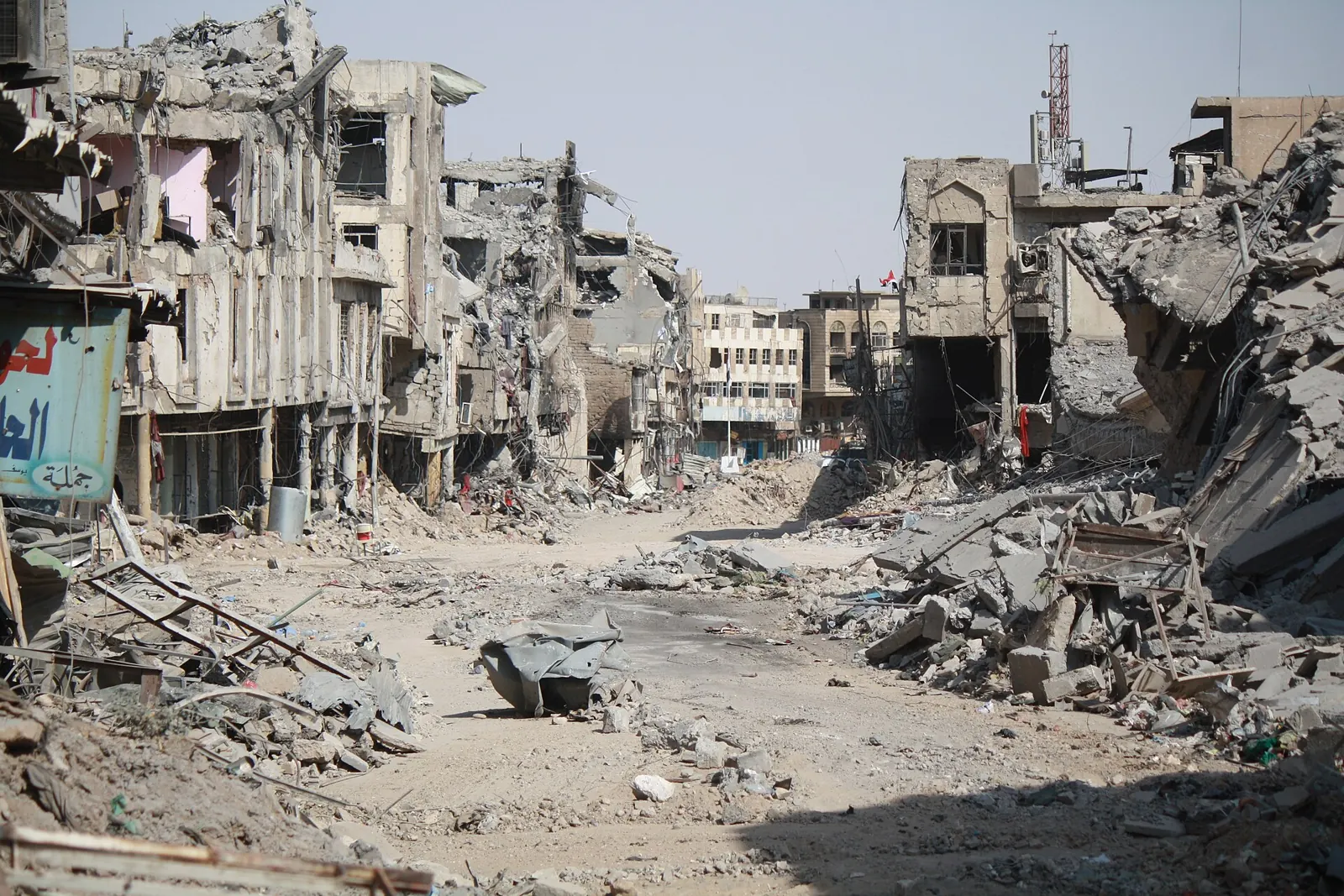
Mosul’s old city, July 9, 2017, as Iraq declared the city retaken from ISIS. H. Mourdock / Voice of America, via Wikimedia Commons, public domain.
The battle for Mosul
In 2016 and 2017, Iraqi forces, backed by US-led air power, retake Mosul street by street over nine months. An Associated Press investigation counted 9,000 to 11,000 civilians killed.
Mosul’s old city, July 9, 2017. H. Mourdock / Voice of America, via Wikimedia Commons, public domain.
Second withdrawal
On September 30, 2026, US Central Command announces that the withdrawal is complete. Iraq marks it with a national holiday, Sovereignty Day. A small US contingent remains to protect diplomats.
200,065
civilians killed in Iraq from March 20, 2003 to March 2026, each death documented by Iraq Body Count. It is the low end of the count’s range.
Many more were never recorded.