A record of the people killed in Gaza, the West Bank and Israel since October 7, 2023, drawn from the Gaza Ministry of Health, UN OCHA, B’Tselem, the Israeli Foreign Ministry, INSS, the IDF and The Lancet Global Health. The sources count differently, so every number here carries its source and its date.
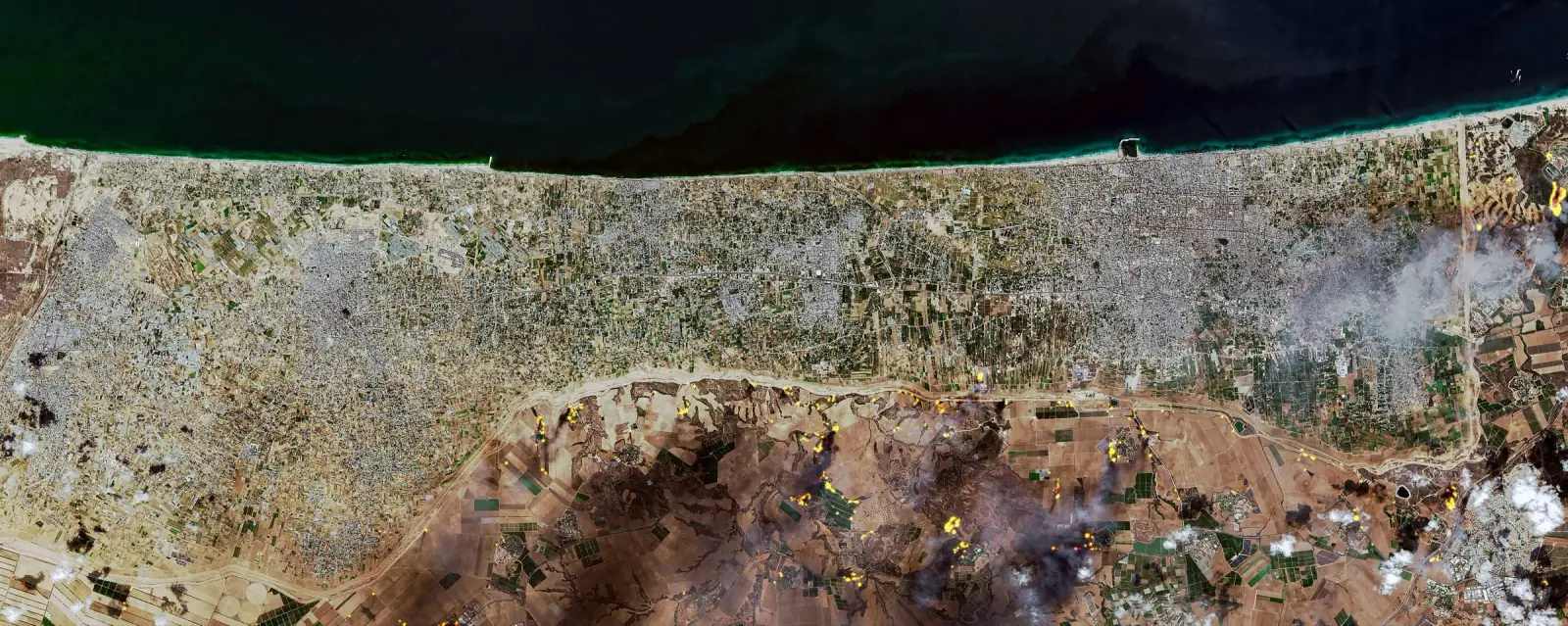
Fires detected in infrared Satellite view of the Gaza Strip and southern Israel, October 7, 2023. Contains modified Copernicus Sentinel data (2023), processed by Pierre Markuse · via Wikimedia Commons · CC BY 2.0
Killed since October 7, 2023
Palestinians killed in Gaza
73,92873,928
20,179 children12,500 women, to
Gaza Ministry of HealthOct 7, 2023 –
About this figureClose
Palestinians killed in the Gaza Strip by direct violence, as recorded by the Gaza Ministry of Health and republished by Tech for Palestine.
The children and women counts were last updated in October 2025 and July 2025.
724 civilians373 security forces98 foreign & other
Israeli MFA, INSS, B’Tselem
About this figureClose
People killed in the October 7 attack on southern Israel.
Of the 98, 71 were foreign nationals; the other 27 are recorded as “other and revised.”
Israeli soldiers killed in Gaza
477477
Ground operation, from Oct 27, 2023
IDF, The Times of Israelto
About this figureClose
Israeli soldiers killed in the Gaza ground operation, which began on October 27, 2023. Soldiers killed on October 7 are counted in the October 7 figure.
PalestinianIsraeli
Latest figures as of ; West Bank as of Sep 14. Also recorded in the West Bank: 4,655 settler attacks, counted as incidents. Each figure is its source’s own count over the period shown; they aren’t added together. How these figures are sourced
In brief
On October 7, 2023, Hamas-led fighters broke through the fence around Gaza and attacked towns, kibbutzim, army posts and a music festival in southern Israel. They killed 1,195 people, most of them civilians, and took 251 hostages.
Israel’s war on Gaza began the same day. In the 1,084 days since, the Gaza Ministry of Health has recorded 73,928 Palestinians killed and 175,030 injured. Of the dead identified by name, 30% were children. In the occupied West Bank, Israeli forces and settlers have killed 1,123 more Palestinians. 477 Israeli soldiers have been killed in the Gaza ground operation.
A ceasefire took hold on October 10, 2025. Fewer people are killed each day, and Israeli strikes continue.
This page tracks those numbers as sources publish them. Part one charts the toll: when, where, and who. Part two steps back a century, following the historian Rashid Khalidi’s account of how Palestine came to this.
Part one
The toll
What 73,928 looks like
Each dot is ten people killed in Gaza. A rule marks every 10,000. Choose a group to see who they were.
Gaza Ministry of Health totals. The Ministry last broke its count down by age and sex on , so children, women and men are shown as of that date; “men” is the remainder after children and women. The dashed line marks that date: dots after it are deaths reported since, not yet broken down.
Nearly a third of the dead were reported in the first three months
Deaths reported in Gaza each week since October 7, 2023. Scroll to walk through the war.
Bar chart of deaths reported in Gaza each week since October 7, 2023
Oct – Dec 2023
The first three months
people were reported killed in the war’s first three months, about a day.
2024
A long, grinding year
Through 2024 the weekly toll fell but never stopped: deaths, about a day. In May, Israel launched its offensive on Rafah, where more than a million displaced people had sheltered.
Jan – Mar 2025
Eight weeks of truce
A truce took hold on January 19, 2025, with an exchange of hostages and prisoners. Weekly deaths fell to their lowest point of the war to that date.
Mar – Oct 2025
The war resumes
Israel resumed its offensive on March 18. Over the next seven months more deaths were reported. In August, UN-backed experts confirmed famine in Gaza City; by mid-2026, 2,615 people had been killed seeking food aid.
Oct 2025 – now
Ceasefire
Since the October 10 ceasefire, about deaths a month have been added. Most are people killed earlier, now being counted: bodies recovered from rubble and deaths added after review.
Deaths reported each week, which is not always the week they happened. Weeks start on Monday; the current week appears once it ends. From January 2025 the Ministry separates new killings from bodies recovered and earlier deaths added after review; before that, all three are inside the totals. Source: Gaza Ministry of Health, via Tech for Palestine, to . How these figures are sourced
The data as a table
Deaths reported in Gaza each month
Month
Deaths reported
Fewer people are killed each day, and the strikes continue.
Since October 10, 2025, Israeli strikes have continued under a ceasefire still nominally in force. Far fewer people are killed each day than during the war.
—
killed a day in new attacks during the resumed warMar 18 – Oct 9, 2025
—
killed a day in new attacks since the ceasefireOct 10, 2025 –
Where the — added to the toll since the ceasefire come from
About — in — is a new killing. The rest are people killed earlier, now being counted: bodies recovered from rubble and deaths added after review.
Stacked bar chart of deaths added to the Gaza toll each month since the October 10, 2025 ceasefire, by type
October counts reports from the 11th, the first after the ceasefire; September runs to the 24th. “New killings” include — people who died later of their wounds. Source: Gaza Ministry of Health daily breakdowns, via Tech for Palestine. How these figures are sourced
Read more
The official Gaza toll has risen by — since the ceasefire. Only about a fifth of that is new killing. The rest are people killed before the ceasefire who are only now being counted: bodies pulled from the rubble, and deaths added to the record after the Ministry of Health’s committee verified them. Those additions arrive in weekly batches, so the steps they create in the cumulative chart above are not new surges in violence.
Under the ceasefire, Israeli forces were to hold 53% of the Strip behind the so-called “Yellow Line.” By March 2026 they held about 64%, and on May 28, 2026, Prime Minister Netanyahu ordered the army to take 70%. The last Israeli hostage held in Gaza, the body of Ran Gvili, was returned on January 26, 2026. None remain in Gaza.
Of the — dead identified by name, — were children.
Identified dead, by age and sex
Waffle chart: one square for every 100 people identified by name, grouped by age and sex
Also among the dead
Journalists
—
Medical personnel
—
Civil defense
—
Died of starvation
—
Aid-seekers killed
—
Ministry of Health totals: — children and — women killed to , when the Ministry last broke its count down; — people injured. Also tracked by OCHA, CPJ, Healthcare Workers Watch, and UNRWA.
October 7
The deadliest day for Israelis since the state’s founding.
724 Israeli civilians
373 security forces
98 foreign nationals & other
Taken hostage
251
Killed at Nova festival
364
Children killed
36
Injured
8,730
1,195 killed in total. Figures consolidated from the Israeli MFA, INSS, and B’Tselem.
Killings have fallen while settler attacks have continued.
Palestinians killed and settler attacks in the West Bank and East Jerusalem each month, as reported by UN OCHA. They are different units, so they get separate charts on their own scales.
Two bar charts sharing a time axis: Palestinians killed per month, and settler attacks per month, in the West Bank since October 2023
October 2023 counts from the 7th. OCHA’s latest report in this data is from , so September is partial. Source: UN OCHA. How these figures are sourced
Part two
The hundred years’ war
The numbers above begin in 2023. The Palestinian American historian Rashid Khalidi argues that the story begins in 1917, and that it is best understood as a colonial war waged against the Palestinians, backed at every stage by the great power of the day.
In The Hundred Years’ War on Palestine (2020), Khalidi divides that century into six “declarations of war.” What follows summarizes his account in our own words, with the numbers from each period. For the full argument, find the book on our reading list.
Prologue · 1899A letter to Herzl
1 of 8
Prologue · 1899
A letter to Herzl
In the name of God, let Palestine be left alone.
Yusuf Diya al-Din al-Khalidi, letter to Theodor Herzl, 1899
Khalidi opens with his own family. In 1899 his great-great-great-uncle, Yusuf Diya al-Din al-Khalidi, a former mayor of Jerusalem, wrote to Theodor Herzl, the founder of political Zionism. He wrote that he sympathized with the plight of the Jews of Europe, but that Palestine was already inhabited, and he urged Herzl, in the name of God, to leave it alone.
Herzl replied that Jewish immigration would bring prosperity to the country’s non-Jewish inhabitants. He did not address the people living there as a nation with rights of its own. For Khalidi, that exchange holds the century to come in miniature.
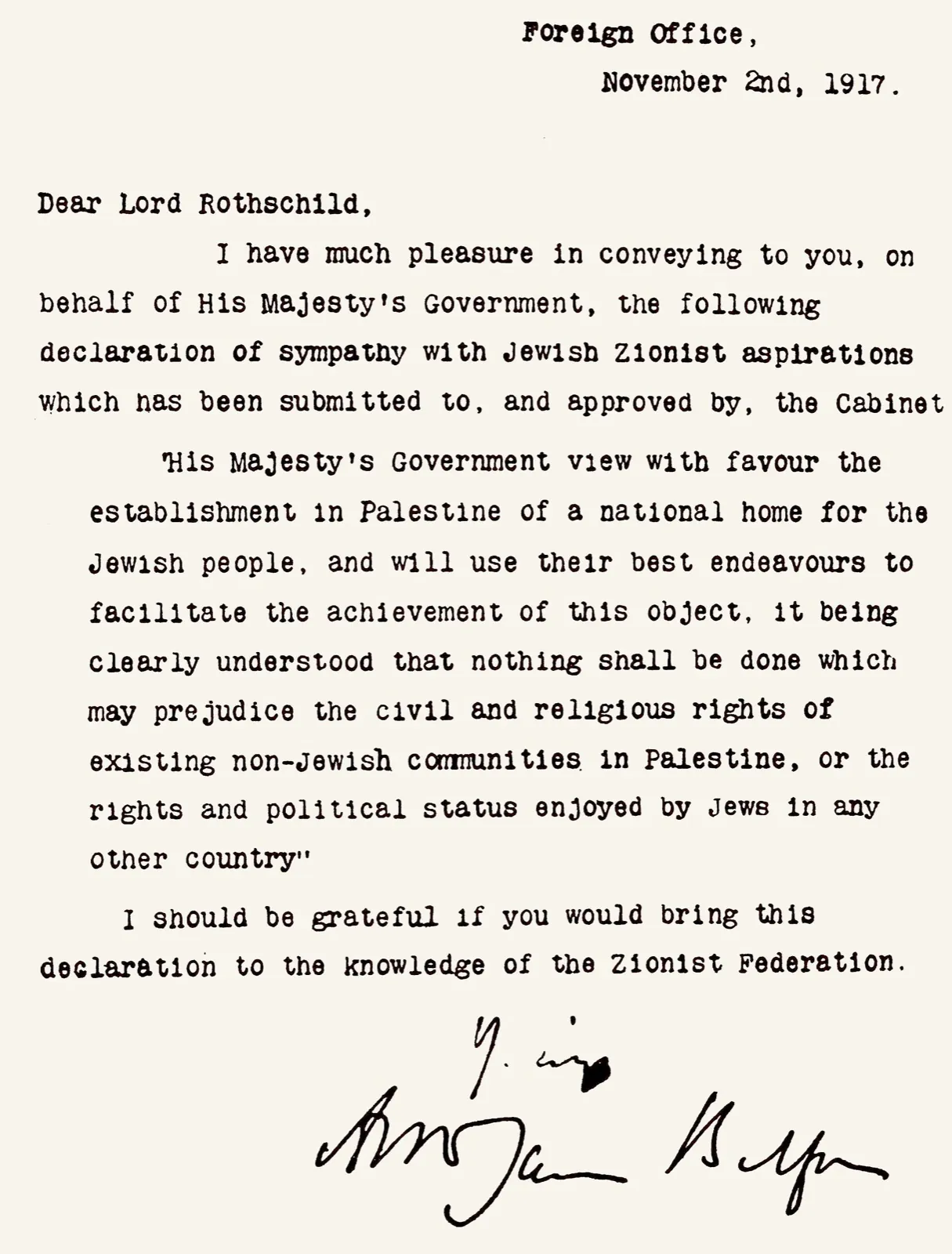
The Balfour Declaration, November 2, 1917: a letter from Foreign Secretary Arthur Balfour to Lord Rothschild. UK Government · via Wikimedia Commons · public domain
1917 – 1939 · The first declaration
A national home, promised by a great power
In November 1917, Britain promised the Zionist movement “a national home for the Jewish people” in Palestine, a country its armies had not yet finished conquering, where Arabs were roughly nine in ten of the population. The letter called that majority “the existing non-Jewish communities,” with civil and religious rights but no national ones.
~90%of Palestine’s population was Arab in 1917
~5,000Palestinians killed as Britain crushed the 1936–39 revolt
Read more
Britain wrote the promise into its League of Nations Mandate for Palestine in 1922 and opened the country to Jewish immigration. The Jewish share of the population rose from about a tenth to nearly a third by 1939.
In 1936 Palestinians launched a six-month general strike and then an armed revolt. Britain put it down over three years with mass arrests, collective punishment, house demolitions and executions. Khalidi estimates that about one in ten adult Palestinian men were killed, wounded, imprisoned or exiled. The Palestinians entered the 1940s with their leadership broken and their fighters disarmed.
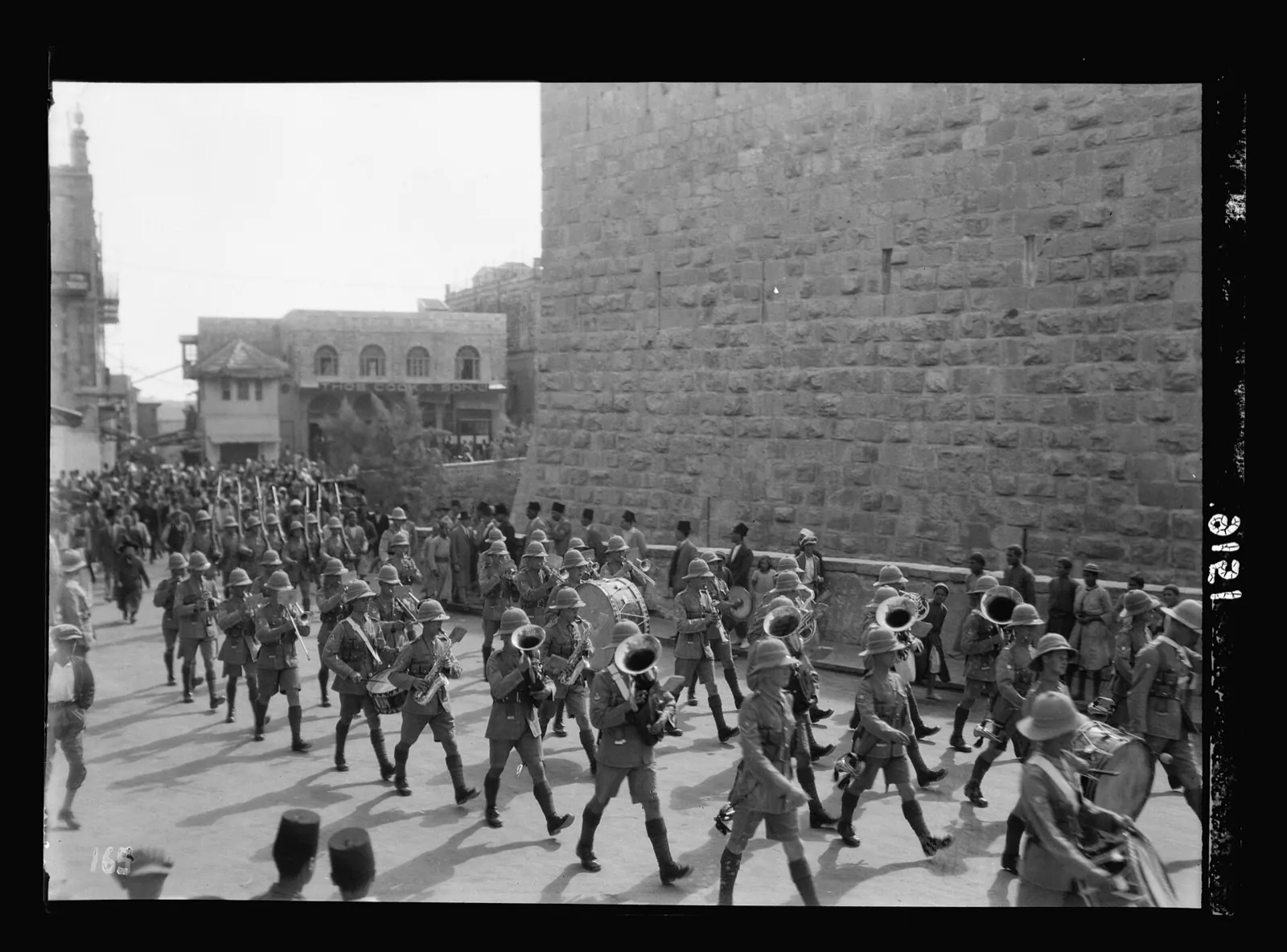
British troops march through Jerusalem inside the Jaffa Gate, 1936. Matson Collection, Library of Congress · via Wikimedia Commons · public domain
In November 1947 the United Nations voted to partition Palestine, allotting more than half the land to a Jewish state when Jews were about a third of the population. Khalidi counts the vote, driven by the United States and the Soviet Union, as the second declaration of war. What followed Palestinians call al-Nakba, “the catastrophe.”
750,000+Palestinians expelled or fled
530+villages depopulated or destroyed
15,000Palestinians killed in 1947–49
6M+registered refugees today
Read more
Between the partition vote and the armistice of 1949, Zionist militias and then the new Israeli army carried out a campaign, documented as Plan Dalet, that emptied more than half of Mandatory Palestine’s Arab population from their homes. At Deir Yassin, in April 1948, more than a hundred villagers were killed. Villages were razed. Survivors were barred from returning, and their land, homes and bank accounts were absorbed by the new state.
Palestinian scholars and UN experts increasingly describe the events since October 2023 as a second Nakba.
Photo: Palestinian refugees leaving Galilee for Lebanon, October–November 1948. Fred Csasznik · via Wikimedia Commons · public domain
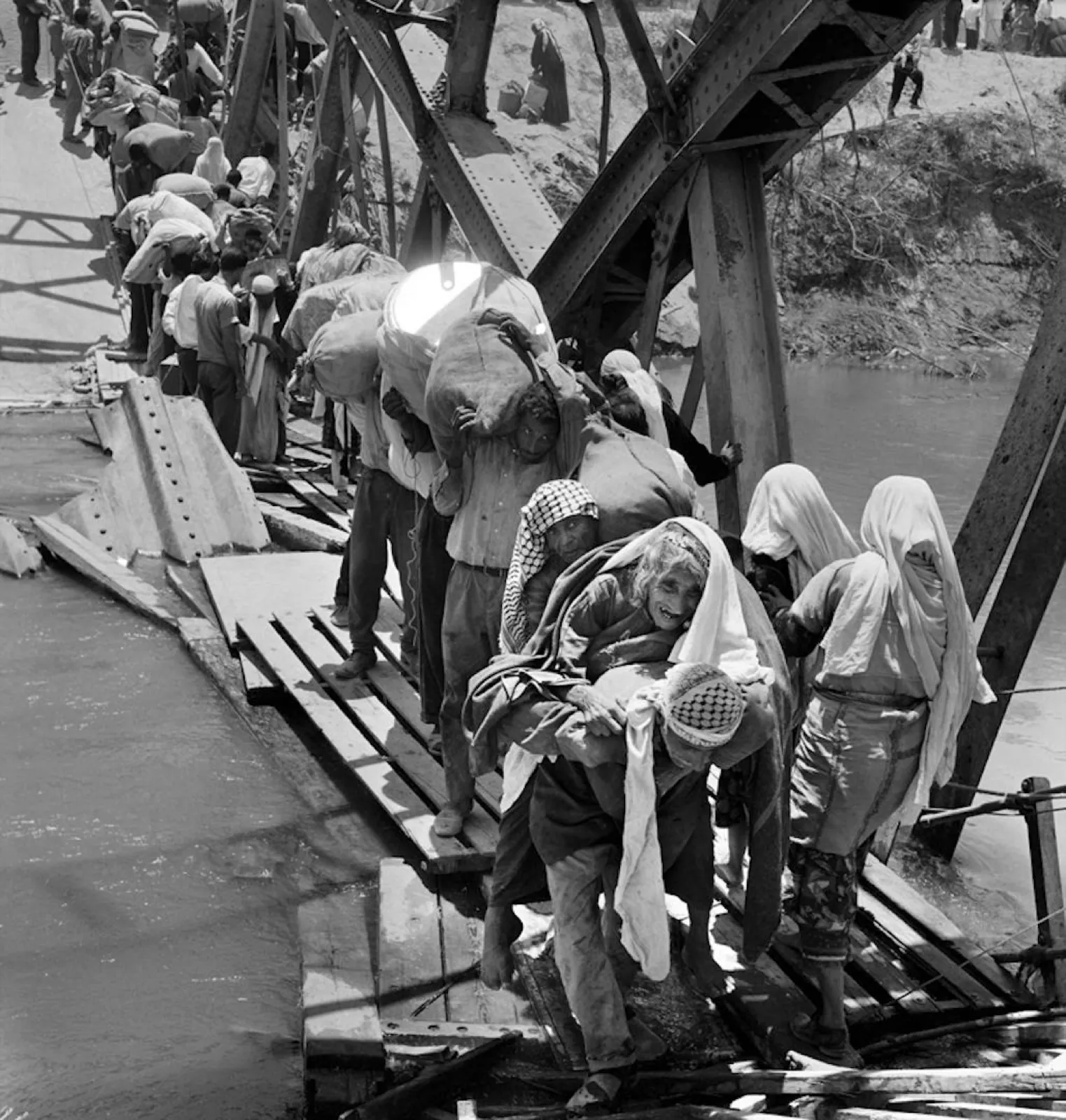
Palestinian refugees cross the wrecked Allenby Bridge into Jordan, 1967. UNRWA Archive · via Wikimedia Commons · public domain
1967 · The third declaration
Occupation
In six days in June 1967, Israel took the West Bank, East Jerusalem and Gaza, along with Egypt’s Sinai and Syria’s Golan Heights. Hundreds of thousands of Palestinians were displaced, many of them refugees for the second time. The occupation that began that week has never ended.
For Khalidi, the third declaration was UN Security Council Resolution 242. It became the basis of every later peace plan, yet it never named the Palestinians, referring only to “a just settlement of the refugee problem.”
300,000+Palestinians displaced in 1967
700,000+Israeli settlers in the occupied West Bank and East Jerusalem today
Read more
Israeli settlement of the occupied territories began within months of the war. Under the Fourth Geneva Convention an occupying power may not transfer its own population into occupied territory, and the International Court of Justice has found the settlements unlawful. They have grown under every Israeli government since.
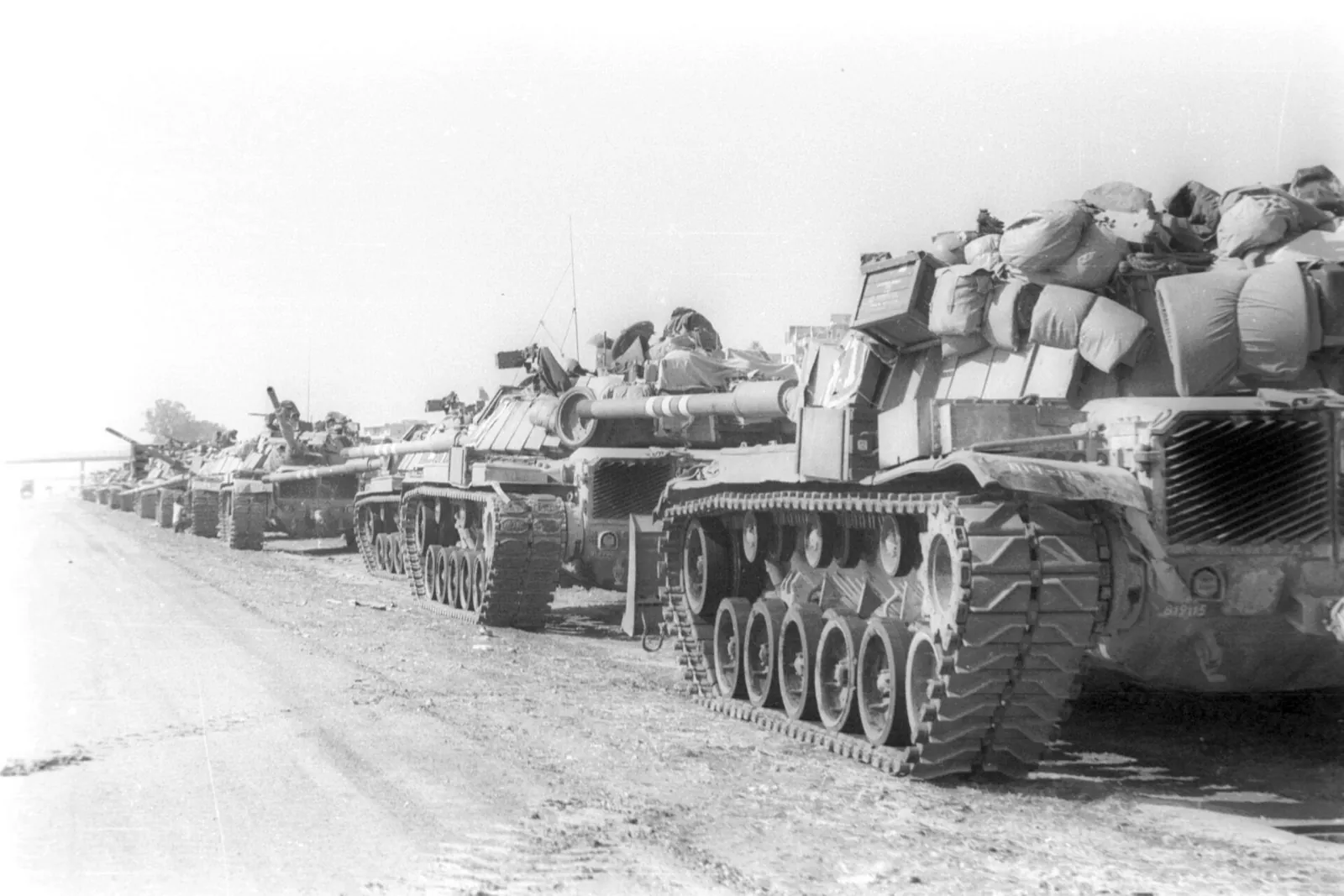
Israeli tanks on the outskirts of Beirut, June 21, 1982. Israel Press and Photo Agency (I.P.P.A.) · via Wikimedia Commons · CC BY 4.0
1982 · The fourth declaration
The siege of Beirut
In June 1982 Israel invaded Lebanon to destroy the Palestine Liberation Organization, and laid siege to West Beirut for ten weeks with American support. Khalidi, then teaching in Beirut, lived through it. After the PLO’s fighters were evacuated under a US-brokered deal, a Lebanese militia allied with Israel entered the Sabra and Shatila refugee camps, which Israeli forces had surrounded, and killed hundreds of civilians over three days.
~18,000killed in Lebanon by September 1982, most of them civilians (Lebanese estimates)
460 – 3,500killed at Sabra and Shatila; estimates vary widely
Read more
An Israeli commission of inquiry, the Kahan Commission, found that defense minister Ariel Sharon bore personal responsibility for failing to prevent the massacre. He resigned as defense minister and became prime minister in 2001.
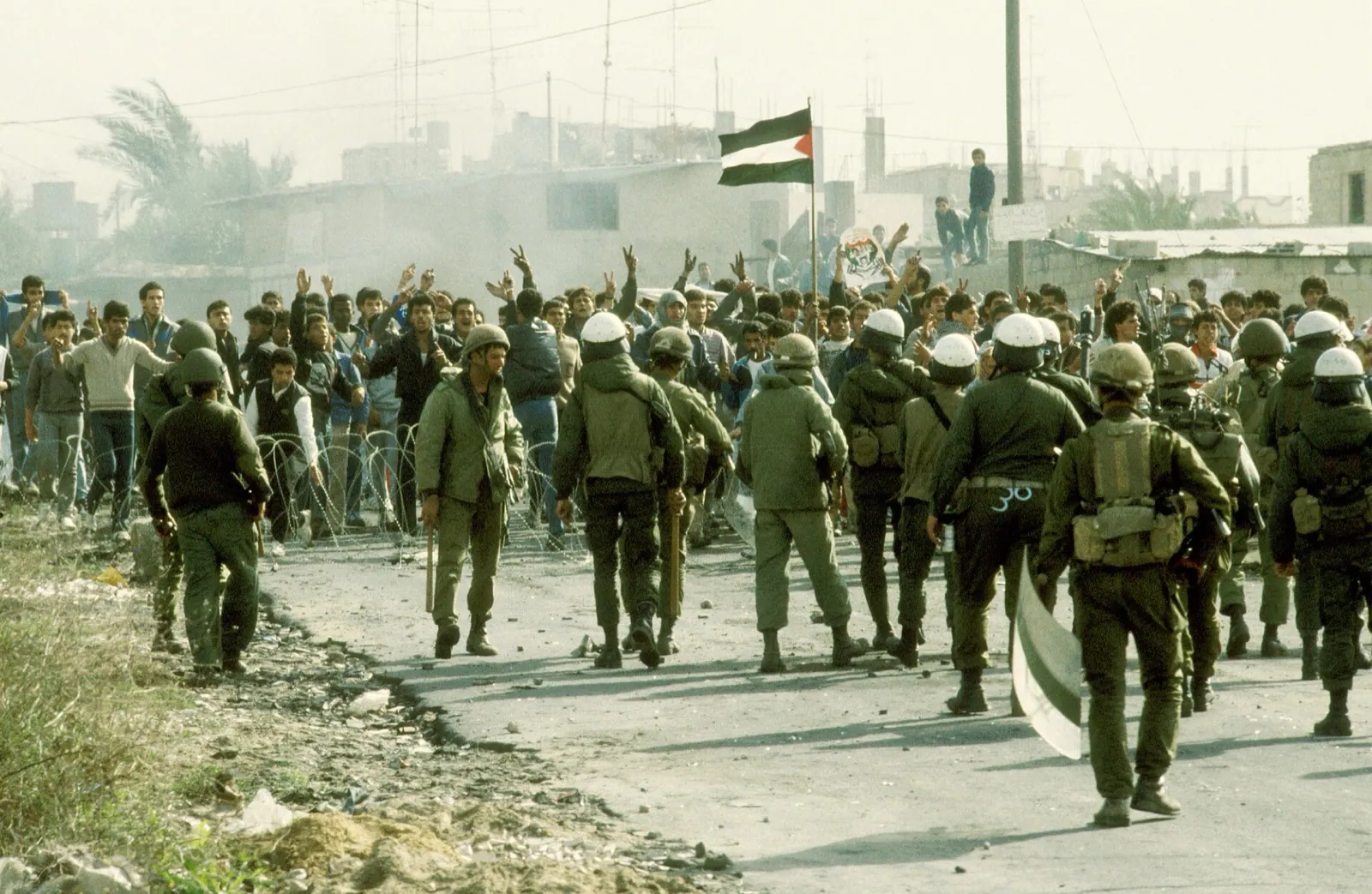
Israeli soldiers face Palestinian protesters in the Gaza Strip, December 21, 1987, two weeks into the first intifada. Efi Sharir · via Wikimedia Commons · CC BY 4.0
1987 – 1995 · The fifth declaration
Uprising, then Oslo
In December 1987 a mass uprising, the first intifada, spread from Gaza’s refugee camps across the occupied territories: strikes, boycotts, stone-throwing, and committees that ran daily life. It put the Palestinians back on the world’s agenda. Khalidi advised the Palestinian delegation at the peace talks that followed in Madrid and Washington.
He argues the 1993 Oslo Accords were the fifth declaration: a Palestinian Authority with limited self-rule, while Israel kept control of land, borders, water and Jerusalem, and settlement kept growing.
1,100+Palestinians killed in the first intifada, 1987–93 (B’Tselem)
~160Israelis killed in the same period (B’Tselem)
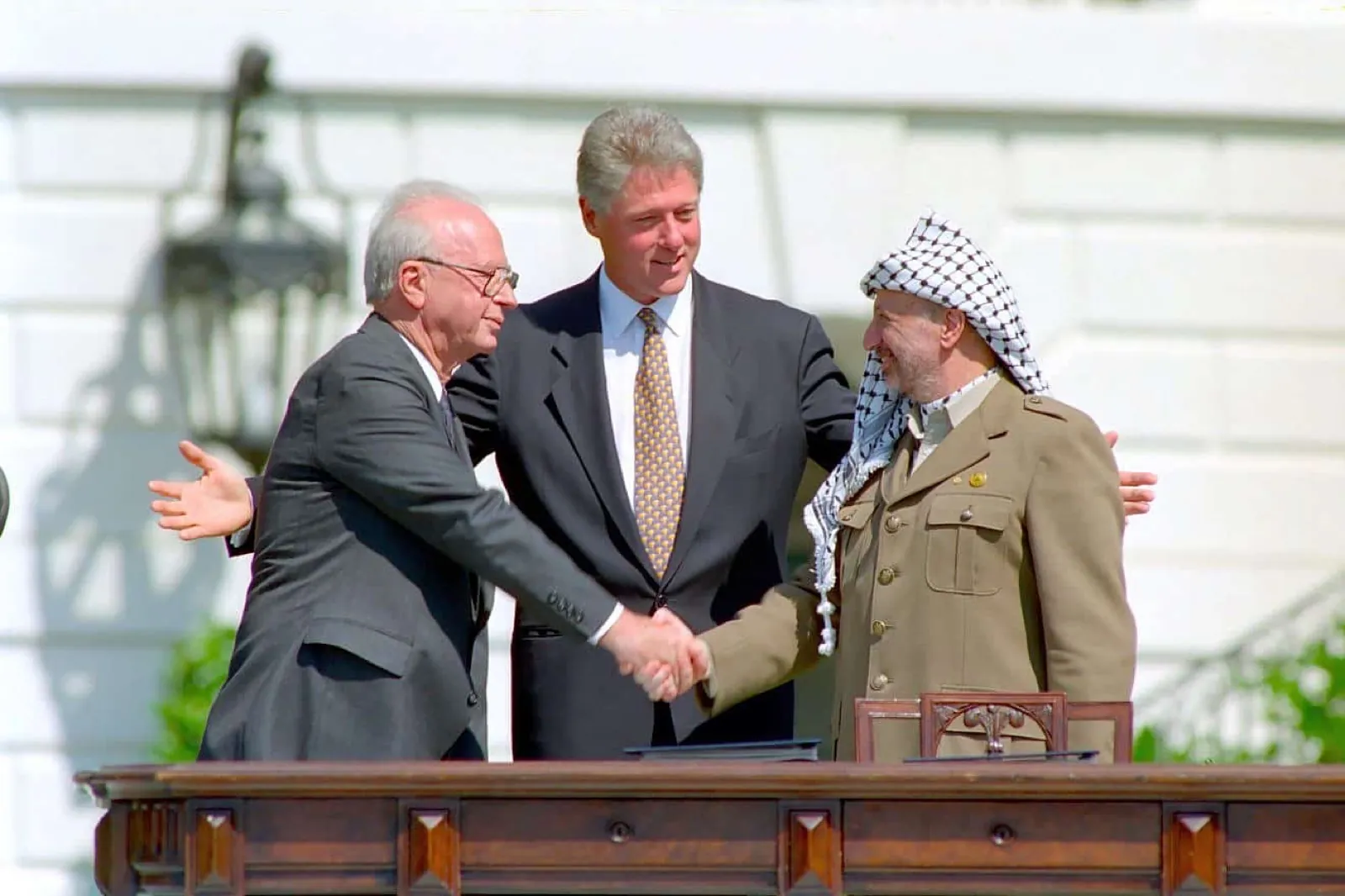
Read moreYitzhak Rabin, Bill Clinton and Yasser Arafat at the signing of the Oslo Accords, September 13, 1993. Vince Musi / The White House · via Wikimedia Commons · public domain
The accords deferred every core question (borders, refugees, Jerusalem, settlements) to talks that never concluded. In the seven years after the handshake, the number of Israeli settlers in the West Bank nearly doubled.
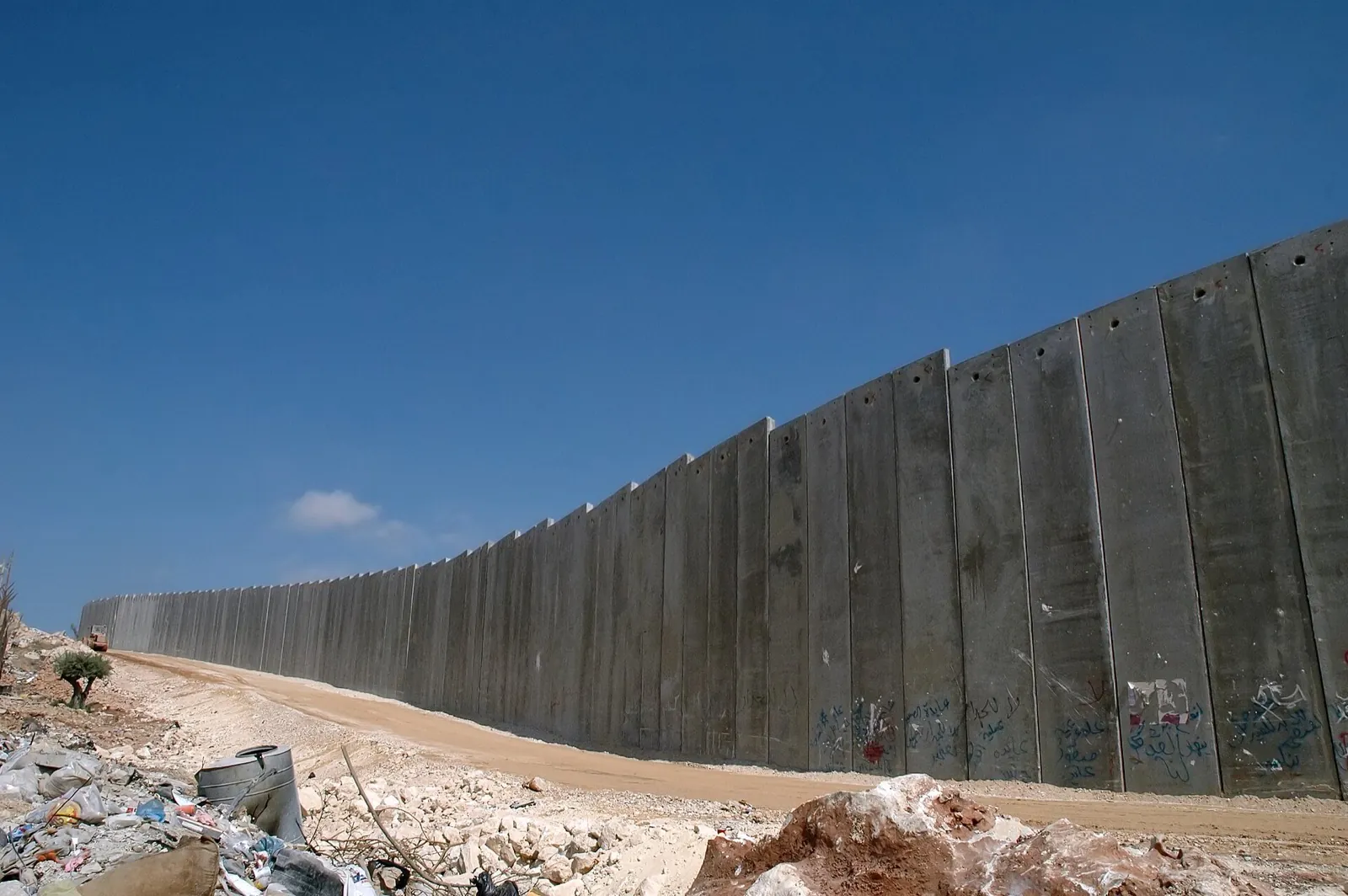
The separation barrier in the occupied West Bank, August 2004. Justin McIntosh · via Wikimedia Commons · CC BY 2.0
2000 – 2014 · The sixth declaration
Walls and a blockade
When talks collapsed in 2000, a second, far deadlier intifada followed. Israel began building a separation barrier, mostly inside the West Bank, which the International Court of Justice found unlawful in 2004. It withdrew its settlers from Gaza in 2005, and after Hamas won Palestinian elections in 2006, imposed a land, sea and air blockade on the Strip that has held since 2007.
Khalidi counts the wars on Gaza that followed, in 2008–09, 2012 and 2014, as the sixth declaration.
~3,000 / ~1,000Palestinians / Israelis killed in the second intifada, 2000–05
2,251 / 73Palestinians / Israelis killed in 51 days in 2014 (UN)
Read more
Of the Palestinians killed in 2014, the UN counted 551 children. Before October 2023, the 2014 war was the deadliest of the Gaza wars.
Khalidi’s book closes in 2017. Since October 7, 2023, the Gaza Ministry of Health has recorded 73,928 Palestinians killed in Gaza, more than all the death tolls above combined. That count is where this page begins, and it is updated as sources publish.
A century of killing, on one scale
Palestinians killed in each period, as given in the sections above
1936–39Revolt against British rule~5,000
1947–49Partition and al-Nakba15,000
1982Invasion of Lebanon (all killed)~18,000
1987–93First intifada1,100+
2000–05Second intifada~3,000
2014War on Gaza, 51 days2,251
2023–War on Gaza73,928
Source comparison
Different authorities count differently — by scope, verification standard, and methodology. Independent estimates run higher than official tolls.
Matched to the same date, the estimate is far above the Ministry’s count
Palestinians killed in Gaza. Filled dots are counts; the hollow dot is an estimate.
Dot plot comparing the Gaza Ministry of Health count with the Lancet estimate for the same period, and the Ministry’s latest count
The Lancet figure is as recorded in this site’s data: violent deaths to January 2025. Its exact window, its uncertainty interval and a link to the study are still to be confirmed, so no interval is drawn.
Source
Palestinians killed
Injured
Scope & methodology
As of
Notes & caveats
No figure is complete. The Gaza Ministry of Health itself states thousands of dead remain under rubble. Peer-reviewed research published in The Lancet Global Health estimated 75,200 violent deaths through January 2025, when the Ministry’s count for the same period was 47,460. The estimate leaves out deaths from starvation, disease and the collapse of health care. As of September 24, 2026, the Gaza Ministry of Health reports 73,928 killed, and Wikipedia’s conflict tracker cites 75,131+ Palestinians killed across Gaza and the West Bank; excess non-violent deaths likely push the true toll substantially higher.
All notes and sources
Some category counts are no longer updated. The Ministry’s children (20,179) and women (12,500) breakdowns, medical personnel (1,701), and journalists (262) have not changed in months; starvation deaths (463) and aid-seekers killed (2,615) were last reported in mid-2026. The Committee to Protect Journalists, after a September 2026 review, counts 191 journalists killed, using a narrower definition.
The age and sex breakdown comes from the Ministry of Health’s list of dead identified by name, which trails the overall total.
OCHA relies on the Ministry for Gaza but independently verifies West Bank incidents. Its counts include fatalities from both Israeli military and settler attacks.
B’Tselem publishes a conservative, named-only database of verified individuals. Its totals trail the Ministry but document each death in detail.
Israeli soldier deaths are taken from IDF press releases and reporting by The Times of Israel. The count shown is soldiers killed in Gaza ground operations since October 27, 2023.
The governorate breakdown shown is a model, not a reported statistic. It distributes the overall Gaza total by pre-war population weighted for reported damage — directional only.
The dashboard is rebuilt from the Tech for Palestine API (which ingests OCHA flash updates and Ministry briefings). Re-running the build pulls the latest daily data.